




TONY’S TAKE – A PREVIEW OF BILLS-BROWNS

by Tony Fiorello
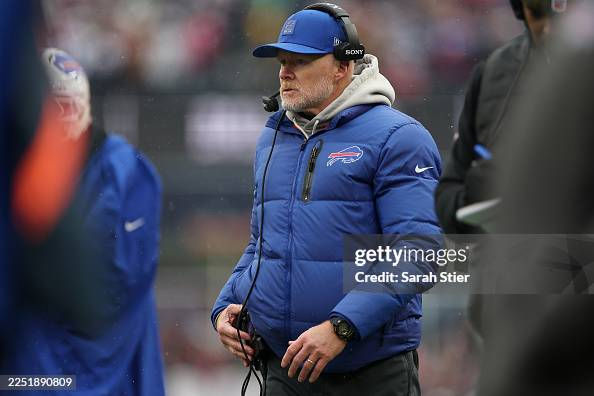
Welcome to Week 16 of the 2025 NFL season. Here at Buffalo Sports Page we will attempt to inform and educate our readers about the Buffalo Bills’ upcoming opponent and what each team might do to emerge victorious.
The Bills’ 15th game of 2025 will take place at Huntington Bank Field in Cleveland, Ohio as they face the Cleveland Browns. Here’s what you should know:

BROWNS’ OFFENSE A BANGED-UP UNIT
Having recycled through multiple coaches and quarterbacks since their rebirth in 1999, the Cleveland Browns’ hiring of Kevin Stefanski from the Minnesota Vikings in 2020 helped Cleveland reach the postseason twice (’20 and ’23) and win their first playoff game since 1994. Stefanski is also the first skipper to lead the Browns to the playoffs twice since Marty Schottenheimer back in the ‘80s.
Stefanski’s offensive system is derived from a colleague of his from his Vikings days, Gary Kubiak – a former head coach with the Houston Texans and Denver Broncos (and offensive coordinator for Mike Shanahan in Denver). Like Kubiak and Shanahan, Stefanski relies on an offense that is West Coast-based in its passing game and is very creative in its ability to attack matchups. It also utilizes a lot of play-action passes, bootlegs and rollouts designed around the threat of outside-zone runs. Stefanski, however, has recently given up play-calling duties to offensive coordinator Tommy Rees.
Cleveland’s quarterback issue is up in the air. In 2022, Stefanski and general manager Andrew Berry pulled the plug on former first overall pick Baker Mayfield and replacing him with ex-Houston Texan Deshaun Watson after multiple sexual misconduct lawsuits and a feud with Texans management forced him to miss the entire 2021 season.
Watson, a three-time Pro Bowler, once displayed a strong arm and his mobility, anticipation and accuracy used to be among the NFL’s best. He was especially adept at executing those traits out of “empty” formations, yet those talents haven’t been seen on a consistent basis in years. Sitting out that 2021 season, plus serving a suspension and a multitude of injuries have all contributed to his decline, and a torn Achilles tendon suffered a year ago has forced him to the sidelines.
After turning to (and later trading) 18-year veteran Joe Flacco, Stefanski and company have split the job under center between a pair of rookies in Shedeur Sanders and Dillon Gabriel. Sanders, the son of Hall of Fame cornerback Deion Sanders and a fifth-round draft pick out of the University of Colorado, will get the start on Sunday – while he doesn’t possess the athleticism his father had, he has some accuracy and is a rhythmic thrower. However, he’s got a tendency to retreat backwards and holds the ball too long with just one hand when under pressure. Sanders also doesn’t employ the strongest arm and – given his lack of experience – doesn’t process coverages quickly and leaves too many throws on the field.
The Browns’ rushing philosophy relies on a mobile offensive line that pushes defenders from sideline to sideline while encouraging its tailbacks to find holes on the opposite side of the play’s direction and cut back against the grain. Executing these blocks are ex-Jaguar Cam Robinson, Joel Bitonio, Ethan Pocic, Wyatt Teller and Jack Conklin (the latter three are all out with injuries).
While the outside/wide zone is the team’s foundational run, Stefanski will also use power plays, traps, sweeps, counters, inside zone, “duo” and pin and pulls as changeup tactics and will throw in some misdirection concepts like end-arounds and reverses as well. This system has made many a star out of running backs for decades and rookies Quinshon Judkins (who boasts strength and balance) and Dylan Sampson (patience and short-area burst) have been a decent one-two punch.
Like his ex-coworker, Stefanski will have his skill players line up in unusual places in the formation to determine if defenses are playing man or zone coverage and will have his wide receivers stay inside the numbers to give them extra room to run routes and to serve as additional blockers. His scheme makes excellent use of shifts and motions to create false reads and favorable angles in the running game and the receivers’ pass patterns work well off one another with many intersecting routes at all three levels.
The Browns’ offense makes liberal use of multiple tight end sets, and David Njoku (a solid red zone target) and rookie Harold Fannin (a good athlete who excels on choice routes) have benefited from it. At wide receiver, ex-Denver Bronco Jerry Jeudy and Cedric Tillman give Cleveland’s quarterbacks weapons to work with.
Cleveland has been putrid offensively in 2025. 29th in scoring and rushing and 30th in passing and total yards, they have a lot of work to do to improve.
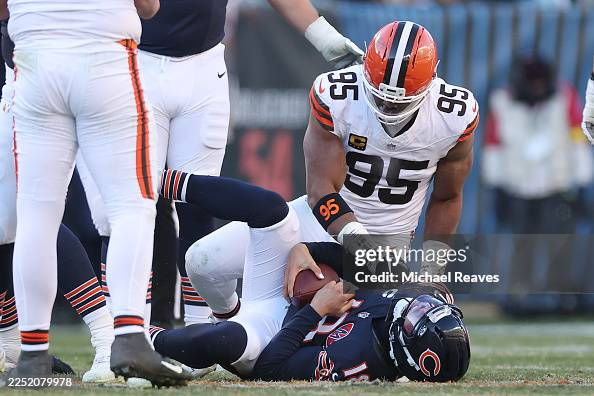
CLEVELAND’S DEFENSE IS TALENTED
Jim Schwartz has returned to the team he started his NFL career with and he’s turned the Browns’ defense from a mediocre one into one of pro football’s best. His system – traditionally one that is built around one-gap principles up front, zone coverage and two deep safeties – is now one that has relied more on single-high coverages (Cover One, Three etc.), and they marry their defensive fronts and blitzes with coverage rotations very well.
All-Pro Myles Garrett has eight straight double-digit sack campaigns and is one of the best pass rushers in the league – in fact, he’s on pace to break the NFL’s single-season sack record (currently held by Michael Strahan in 2001 and T.J. Watt in 2021). The big, quick defensive end from Texas A&M is joined on Cleveland’s defensive line by veterans Maliek Collins and Alex Wright and rookie Mason Graham.
The Browns have some nice chess pieces in their secondary to execute Schwartz’s schemes. They employ one of pro football’s best cornerbacks in Denzel Ward – who specializes in matching up with smaller, quicker wideouts – and Tyson Campbell starts opposite him (Ward’s out for Sunday). At safety is Grant Delpit and Ronnie Hickman. At linebacker the Browns employ a playmaker in rookie Carson Schwesinger, and he teams up with journeymen Devin Bush and Jerome Baker.
While Cleveland is just 19th in points allowed and 14th against the run, they’re second in total yards and first against the pass. They’re also third in the league in sacks and 10th in blitzing percentage.

BUFFALO’S DEFENSE USUALLY GOOD, BUT HAS HAD A ROUGH 2024 AND ‘25
For most of head coach Sean McDermott’s time in Buffalo, the Bills’ defense was one of the league’s best. Points allowed (fourth in the NFL in that category in 2023), total yards per game allowed (ninth), passing yards given up (seventh), rushing yards surrendered (15th), takeaways (third), interceptions (tied for fourth) and sacks (fourth, tied for second-most in their history with the 2014 team) have generally been the categories that the Bills have excelled at over the years, with 2023’s sack total being the best of the McDermott era.
2024, however, was a year of transition for the Bills on defense. Due to age and salary cap complications, out the door were longtime veterans such as Jordan Poyer, Tre’Davious White, Dane Jackson, Shaq Lawson, Leonard Floyd, Linval Joseph, Tim Settle, Kaylon “Poona” Ford and Tyrel Dodson.
Especially when one includes names from the past on the defensive line such as Kyle Williams, Marcel Dareus, Jerry Hughes, Mario Addison, Star Lotulelei, Quinton Jefferson, Carlos “Boogie” Basham, Trent Murphy, Vernon Butler, Justin Zimmer, Efe Obada, Harrison Phillips, Dawuane Smoot, Austin Johnson and Casey Toohill – that’s a lot of turnover during the last eight years. The answer, according to McDermott, general manager Brandon Beane and defensive coordinator Bobby Babich, is youth and cheap veterans to provide cost-effective depth (Buffalo made it to the AFC title game last year with the third-most dead money on the salary cap in the NFL and used just 71 percent of the cap).
Some of those younger players – albeit young veterans since they are in their fifth and sixth professional seasons, respectively – who have been asked to take on a greater role include Greg Rousseau and A.J. Epenesa, who can both line up on the edge and go inside in passing situations. Da’Quan Jones, perhaps their best run-stuffing lineman, is effective on T-T stunts with Ed Oliver (out for the rest of the regular season), an excellent gap penetrator.
They are backed up by familiar faces in Lawson and Jordan Phillips (out for Sunday) and second-year men Javon Solomon and DeWayne Carter (Carter is out for the season with a torn Achilles tendon) while rookies Deone Walker, T.J. Sanders and Landon Jackson (currently injured) learn the ropes of the NFL. Ex-Charger Joey Bosa, a five-time Pro Bowler and 10-year pro, fills the role that future Hall of Famer Von Miller settled into after a torn ACL 11 games into his first season compromised his play on the field. Additionally, veterans Matthew Judon, Larry Ogunjobi and Michael Hoecht provide valuable depth (Hoecht, out for the season after tearing his Achilles tendon, is an intelligent and versatile chess piece who can be deployed in multiple ways).
Over the years Buffalo has been inconsistent in two areas – creating a consistent pass rush and stopping the run. The run issues are mainly caused by poor tackling (their missed and broken tackle percentage has been among the highest in the NFL for years), a lack of gap integrity and ability to get off blocks, subpar eye discipline, inefficient communication and an inability to handle motion and misdirection (which causes issues with leverage, spacing and run fits). Perhaps the infusion of new faces can eventually put those issues to bed once and for all, but they’ve reared their ugly heads yet again in 2025.
Schematically the Bills’ defense mostly relies on basic zones after the snap (they’re typically among the top units in the NFL in usage of coverages with two high safeties such as Cover Two, Four and Six, although they’ve used more single-high coverages recently so they could put more bodies in the box to stop the run and to limit communication) but before the snap it is complex. Safety rotations to disguise their intentions keep opposing quarterbacks guessing and selective pressure looks at the line of scrimmage and coverage exchanges are the team’s calling cards.
Those blitz looks usually happen in the A-gaps with the smaller, but smart, speedy and athletic Matt Milano and Terrell Bernard to confuse opposing offensive lines and quarterbacks, but Buffalo rarely sends five or more pass rushers – their favorite blitz tactic besides A-gappers are four-man zone exchanges. In 2024’s regular season they were 27th in blitz rate but Buffalo blitzed Lamar Jackson on 15 out of 31 drop-backs (48.4%) in the playoffs, their fifth-highest blitz rate in a game under McDermott and their highest in a game since Week 15 of 2021, according to Next Gen Stats.
Bernard has become a good blitzer and coverage ‘backer – his 6.5 sacks in 2023 were the most by an off-the-ball linebacker in Bills annals and he became the first NFL player since Seth Joyner in 1991 with six sacks, three picks and three fumble recoveries in a season. He and Milano are also adept at being used to spy quarterbacks – they spied Jackson on every third down in last year’s postseason – but Bernard, like most of his teammates, has dealt with injuries and hasn’t quite looked like himself.
For the third straight year, Milano suffered another major injury – this time a pectoral problem (although he’s healthy for now). When he misses time, Dorian Williams usually picks up the slack. Williams has displayed flashes of quickness and burst but is sometimes slow to key and diagnose at the line of scrimmage. He also takes many false steps and needs to process better while in coverage, but is athletic, long and fluid and has improved with more experience game by game. He had increased playing time in the playoffs to stop Baltimore’s running game, as evidenced by being on the field for a third of Buffalo’s snaps.
Additional depth comes from former Carolina Panther Shaq Thompson and Joe Andreessen. Andreessen, a University at Buffalo product who hails from nearby Lancaster, showed excellent diagnostic skills at the line of scrimmage in the preseason while also displaying strong hands, a quick downhill trigger that allows him to shoot gaps well and some speed and range. It helps that he played in a similar role as Milano while in college. Thompson, meanwhile, has turned back the clock with some strong performances in both pass coverage and run support.
The Bills have mainly utilized nickel personnel over the last several years (90.8 percent in ’21, 94.8 in ’22, 79.7 in ’23, 78.3 last year and around 60 so far this year) but their percentage of 4-3 base personnel has gone up this year to combat the run (around 20 percent in ’25). When Milano is out with injury, they’ve also increased their usage of dime personnel with three safeties to help offset his loss in pass coverage (17.2 percent in ’23, 15.9 in ’24 and around 20 so far this year) and in the past, that setup featured Poyer near the line of scrimmage, Micah Hyde and ex-Ram Taylor Rapp on the back end.
The Bills’ safety position is currently manned by the aging but still capable Poyer and Cole Bishop (an underrated and cerebral athlete who can also drop down in the box). Rapp, who is better playing near the line of scrimmage and the rangy and physical but inconsistent Damar Hamlin are both on injured reserve – filling their absence is veteran Darnell Savage.
At the boundary cornerback spots are White (who, like Poyer, is back after a year away to replace Rasul Douglas) and Christian Benford, and they are backed up by Jackson (another experienced face back on the practice squad) and speedy rookies Max Hairston and Dorian Strong (also on injured reserve). Slot corner Taron Johnson remains strong in the quickness and tackling departments and he’s backed up by Cam Lewis and rookie Jordan Hancock, who can both fill in at safety too. Hancock has shown to be effective as a single-high post defender.
2024 saw the Bills end the regular season 11th in points allowed, 12th against the run, 17th in total yards, tied for 18th in sacks and 24th versus the pass. They were also 29th in third down percentage, gave up the most completions, yards and touchdowns in the NFL on screen plays and allowed nine touchdowns on plays of four seconds or longer – the most in the league according to Cover 1’s Eric Turner. However, they were third in takeaways and were fifth-best in allowing plays of 20 yards or more.
Yet this unit’s 2025 season has been quite uneven. Although they’re second versus the pass, they’re just 12th in total yards given up, 16th in points allowed and third-worst versus the run (their number of takeaways has gone up – Buffalo had just five in their first six games and now have had 13 in their last eight). Clearly McDermott – who has had a bigger say in play-calling on gameday lately – and Babich have their work cut out for them on this side of the ball.

BILLS’ OFFENSE IS UPPER-ECHELON, BUT QUESTIONS PERSIST ABOUT PASSING GAME
For six consecutive seasons, the Bills have boasted one of the NFL’s elite offenses for the first time since the K-Gun was running roughshod over the league more than 30 years ago. Led by quarterback Josh Allen’s improved processing skills both pre and post-snap, ball placement, patience within the pocket and touch on passes and a cadre of gifted pass-catchers, those factors allowed Buffalo to become one of the most feared attacks in pro football.
Last year the strong-armed and mobile Allen was ninth in passer rating and rushing touchdowns and tied for seventh in passing scores. That allowed him to be named the NFL’s Most Valuable Player by the Associated Press, an honor previously bestowed upon just two other Bills (Thurman Thomas in 1991 and O.J. Simpson in ‘73).
In 2023 Buffalo was sixth in scoring, fourth in total yards, seventh in rushing and eighth in passing. They were also fifth in red zone efficiency, yet their offense performed poorly over a six-game stretch where they averaged just 20.5 points per game. It resulted in then-offensive coordinator Ken Dorsey getting the boot in favor of quarterbacks coach and former Carolina Panthers play-caller Joe Brady.
Like their defensive counterparts, the Bills went through changes on this side of the ball because of age, the salary cap and a new coordinator. With Brady taking over the role full-time, the biggest philosophical question on offense for Buffalo was how to retain elements of what made them so good in the first place while adding new and fresh concepts.
Between 2018 and ‘23, Buffalo’s offense was an Erhardt-Perkins system brought in from New England by then-coordinator Brian Daboll. It was built upon concepts involving option and crossing routes from the slot, downfield routes from the outside, run-pass options (especially in the red zone), designed quarterback runs to take advantage of Allen’s mobility and alignments that created favorable matchups and some trick plays with jet/orbit motion and sweeps. It was mostly out of “11” personnel groupings (one back, one tight end and three wide receivers) and “10” personnel (one back, no tight ends, four receivers) – and they would also go no-huddle from time to time to limit the opposition’s defensive calls.
The Bills’ multi-receiver sets were traditionally their offensive calling card. In 2020 they used four wide receivers or more 155 times – the second-most in the NFL at the time – and they utilized someone in motion on 43 percent of their offensive snaps, a huge increase from their 25 percent rate in 2019. Daboll, the ex-head coach of the New York Giants, also called for a passing play on 64 percent of their first downs, according to ESPN Stats and Information – no team with a winning record in the prior 20 years did it more than Buffalo. Heading into Week 16 the Bills are now the opposite as they pass on first down at one of the lowest rates in the NFL.
Daboll’s successor, Ken Dorsey, got away from some of those concepts and tried to rely on the talent at his disposal winning one-on-one matchups instead of having the scheme get them open. Once Brady was promoted, the Bills returned to them. He also included more under-center formations and play-action (which can still stand to increase after being a top-four team in run-fakes in 2020 and ’21), pre-snap shifts, motions and designed passes to running backs and route combinations with defined reads for Allen so he can play within timing and structure, but he does need to be better at creating spacing in his route concepts – especially at the intermediate levels.
Brady got his start in the NFL working for the New Orleans Saints and then-coach Sean Payton. Payton himself came from a melting pot of a background including stints running the Erhardt-Perkins scheme for Bill Parcells in Dallas and learning the West Coast offense from Jim Fassel with the New York Giants and from Jon Gruden during their one-year stint together in Philadelphia in 1997, so Brady will bring a similar approach to the table while likely keeping some things the same in Buffalo.
Their biggest transaction on offense last year was trading the aging Stefon Diggs to Houston. Diggs (now in New England), while never a burner on the outside, was an exceptional route runner who specialized in making contested catches and operated well out of bunch and stack formations – leading him to re-write many of the Bills’ single season receiving records.
In addition to Diggs, Buffalo has let veterans like John Brown, Emmanuel Sanders, Cole Beasley, Isaiah McKenzie, Jamison Crowder, Trent Sherfield, Deonte Harty and Amari Cooper walk over the years. Many of them were productive, but nothing can last forever – hence the overhaul of the Bills’ wide receiver room.
The Payton offense is built through having big, physical targets who can get open over the middle of the field, especially on deep in-cuts, or “dig” routes (although Buffalo hasn’t utilized them much). Payton has employed such players in those roles before like Marques Colston, Jimmy Graham, Michael Thomas and Courtland Sutton, and the drafting of Keon Coleman from Florida State last year fits the bill for Brady.
Coleman, whose game evoked comparisons to Colston, Brandon Marshall and Anquan Boldin coming out of college, brings size and physicality to the boundary ‘X’ position (and possibly the slot) with good body control and strong hands to make contested catches and has some run after the catch ability. He does need to work on his speed, quickness and ability to beat press coverage – along with learning how to be a pro athlete – but in time he may improve in those areas.
Along with Coleman is Curtis Samuel (out for Sunday), who can line up both in the slot and outside the numbers and take handoffs, free agent pickup Joshua Palmer and the speedy pair of Brandin Cooks and Mecole Hardman. Shifty pass-catcher Khalil Shakir (who leads the NFL in yards on screen passes) mans the slot with his quickness, sure hands and savviness to get open versus zone coverage, Gabriel Davis has returned to supply depth and Tyrell Shavers, a good blocker, has proven to be a new weapon after making the team’s active roster out of training camp. Overall, this group doesn’t possess a ton of speed beyond Cooks and Hardman – which makes the ability to manufacture intermediate and vertical plays harder.
Tight end Dawson Knox is joined by Dalton Kincaid and their diverse skillsets have allowed the Bills to throw curveballs at opponents with multiple tight end sets. Kincaid, who can line up as the boundary ‘X’ receiver in three-by-one alignments, lived up to the hype with 73 receptions as a rookie two years ago, the most of any first-year Bill and surpassed Pete Metzelaars for the most catches by a Bills tight end in one season. He also became the fourth rookie tight end since 1960 with 70 or more catches in a year.
The Bills’ offensive line is composed of Dion Dawkins (who ranks second in the NFL in pass block win rate), David Edwards, Connor McGovern (taking over at center for the departed Mitch Morse), O’Cyrus Torrence and Spencer Brown. This crew, along with fullback Reggie Gilliam has mainly executed outside zone runs along with zone-reads, pin-and-pull concepts, traps (especially with Dawkins as the puller), counters, sweeps, split inside zone/duo and sprint draw plays sprinkled in for running back James Cook.
Cook, who has rushed for over 1,000 yards in three straight seasons – the first back to accomplish that feat for Buffalo since Thurman Thomas did it eight years in a row from 1989-96 – boasts great vision, patience, burst and cutback ability (he also has six fumbles, the most in the NFL) and is backed up by physical second-year man Ray Davis, who is also excelling as a kick returner (he leads the NFL in return average). Ex-Jet Ty Johnson brings solid receiving skills to the table.
The starting front five used to be iffy in providing push in the running game and in pass protection but has become a strength in recent years. In the past, most of the team’s rushing production came from Allen’s legs and few came from their backs – the Bills’ rushing attempts per game in 2022, 18.2, was last in the NFL but that number has jumped to the highest in the NFL since Brady was promoted. In 2023 Allen was taken down just 24 times overall in 17 regular season outings, the best mark in pro football, and the team again led the league with just 14 sacks allowed last year (tied for the sixth-least since 2000).
Buffalo also carried over their trend of using an extra offensive lineman to help in the running game. Now that Edwards has moved into the starting lineup, the sixth guy is currently Alec Anderson and the Bills had the highest rate of offensive snaps with six linemen on the field in ’24 – with most of them being called runs, and were near the top of the NFL in yards per carry and yards per play with six linemen on the field (rookie tight end Jackson Hawes, an excellent blocker and the replacement for Quintin Morris, is being used more in this regard with “13” personnel looks which diversifies what they can throw at opponents).
Another area the Bills needed to clean up was protecting the ball. They used to be one the league’s sloppiest teams – Allen had 14 interceptions and 13 fumbles in 2022 and he led the NFL with 18 interceptions in ’23. Last year Allen cut down on his interception total significantly with just six – a sign of progress in this regard (Allen became the third signal caller in NFL history to start a season with 10 touchdowns and no picks through his team’s first seven games).
In fact, the Bills tied the league record for fewest turnovers in a season with just eight (with the 2019 Saints). They also became the first team ever with less than 15 sacks allowed and fewer than 15 turnovers in the same season.
Buffalo ended the 2024 regular season second in points scored (the highest scoring team in franchise history) and red zone efficiency, 10th in total yards and ninth in rushing and passing and became the first team to ever have 30 passing and 30 rushing touchdowns in one season. They, along with the Chiefs, Philadelphia Eagles and Washington Commanders, were also the top four teams in the NFL on fourth down conversion rate.
So far they’re first in the NFL in rushing, third in total yards and scoring, 13th in passing and near the top of the league in explosive offensive plays (rushes of 10 yards and passes of 20 yards), under-center run rate (especially on “duo” calls) and red zone efficiency. The Bills also have the most second half runs in the NFL and the best second half point differential (plus-116), yet they’ve outscored their opponents by just 3.1 points-per-game since Week 10.
Ex-49er Mitch Wishnowsky is the team’s third punter this year (he didn’t punt once against the Bengals – the first time the Bills have done that in three years) and kicker Tyler Bass is out for the season due to a groin injury – with 41-year-old former All-Pro Matt Prater replacing him. Prater, who holds the NFL record for most 50-plus yards field goals in a career, also owned the league mark for longest career field goal after he connected on a 64-yarder in 2013 but he’s out for Sunday and will be replaced by former Charger and Colt Michael Badgley.

12 FACTS TO MUSE OVER
· Allen has tied Cam Newton for the most seasons ever (six) of 3,000 passing yards and 500 yards on the ground. He also has 37 total touchdowns, tied with the Rams’ Matthew Stafford for the most in the league.
· Buffalo has forced a turnover in 19 straight home games – their longest streak since a 31-game outing from 1988-92.
· Bosa is one forced fumble away from breaking the franchise record for the most in one season – he’s tied with Bruce Smith in 1990, Nate Clements in 2004 and Aaron Schobel in 2007.
· Buffalo is 25-4 in December and January regular season games since 2020 – tops in the NFL. Their record against teams who are .500 or better is 6-2 (their mark against divisional opponents is 27-8 since 2020, best in the league).
· Before the Bengals game, the Bills had lost their last 25 games when giving up 21 points or more in the first half (which was the longest active streak in the NFL). Now they’ve won two of those games in a row, and their 21-point comeback against the Patriots is tied for the third-biggest in team annals – they’ve also trailed by at least 10 points in the fourth quarter three times this year including the Ravens game and have won all three times.
· The Bills are now 9-0 when they play a team they lost to previously in the season since 2021.
· Knox has surpassed Pete Metzelaars as the team’s all-time leader in scores amongst tight ends, and long snapper Reid Ferguson has moved past former kicker Steve Christie into second place in team annals for most consecutive games played. He currently has 145.
· With their next win, the Bills will clinch a playoff berth for the seventh straight season – a new franchise record. Previously it was six from 1988-93.
· Buffalo’s record against rookie quarterbacks since 2019 is 9-3.
· Incredibly, the Bills’ record is 4-1 when allowing 30 points or more in 2025 – the rest of the NFL is 10-98-2. They’re also 4-2 when surrendering 185 rushing yards or more when everyone else is 4-26.
· Since the beginning of the McDermott-Beane era in 2017, Buffalo has played against the Cleveland Browns just twice – the fewest of any AFC team.
· Cook is on pace to become the first Bill to lead the NFL in rushing since O.J. Simpson in 1976, and if he gets 89 yards against the Browns he’ll have the third-most rushing yardage in a season ever by a Buffalo Bill.


Comments